Viking Range Repair
Viking Ranges on Propane East of Issaquah
Homes east of Issaquah that cook on propane: how an LP Viking range differs from one on the town gas main, what goes wrong when the setup does not match the fuel, and what an owner can check safely.
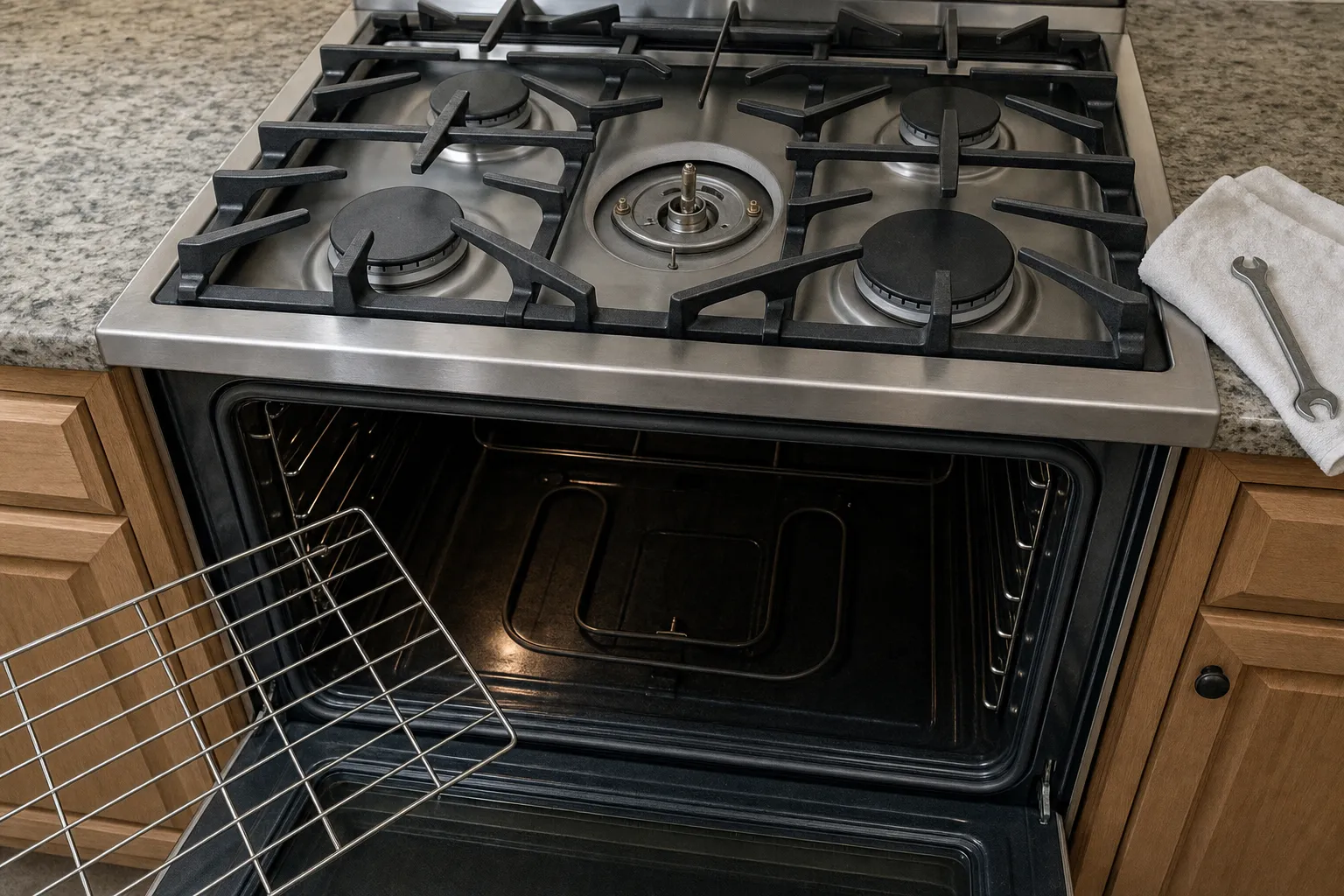
Inside town, a Viking gas range is usually fed from the natural gas main. The main does not reach everywhere, though, and some homes past the edge of town, out along the roads toward Preston, Mirrormont, Tiger Mountain and May Valley, run their range from a propane tank instead. A range on propane cooks as well as one on the main, provided it was set up for the fuel it actually burns. When it was not, or when the change was only half made, the faults look like worn parts and are often treated as worn parts.
This note covers what differs on a propane range, how to tell a supply problem from a range problem, and where the owner’s part stops.
What changes when a range burns propane
Propane and natural gas are not interchangeable. Propane carries more heat in each cubic foot and reaches the burners at a higher pressure, so a range set up for one fuel has to be altered before it burns the other. Two parts do most of that work.
The first is the orifice at each burner, a small brass fitting with a precisely sized hole that meters gas into the burner. A propane orifice has a smaller hole than a natural gas one, because less of the richer gas is needed for the same flame. The second is the pressure regulator, which holds the gas at a steady pressure inside the range. Viking’s installation manuals for its professional freestanding ranges list a different manifold pressure for each fuel and state that the range’s built-in regulator must never be bypassed. The pressure regulator page explains how that part fails and why its checks need a gauge.
The oven burners have orifices of their own, and the low-flame setting on each top burner may need resetting so that a simmer stays lit without running hot. The whole set of parts involved is described on the page about the LP conversion kit.
The same manuals ask the installer to confirm, before anything is connected, that the model suits the gas supply, and they place any conversion with the dealer, a qualified plumber or a gas service company. This note explains the parts; it does not offer or price the conversion itself.
Signs the range and the fuel do not match
A range burning propane through natural gas orifices gets far more gas than its burners can mix with air. Expect tall, soft flames with yellow tips or yellow all through, soot on the bottoms of pans, a smell of unburnt gas, and a simmer that will not turn down far enough. The oven may blacken its walls and smell as it preheats. A range that behaves like this should not be used until it has been checked.
The opposite mistake, natural gas through propane orifices, starves the burners. Flames are small and weak, a large pot takes an age to boil, and the lowest setting may go out on its own. It is less alarming, but no better for cooking.
A conversion left part-finished sits between the two. The top burners may look right while the oven soots, or the burners may burn cleanly on high and then lift and die at low, because the low-flame settings were never touched.
Supply trouble or range trouble
Not every weak flame on a propane range is the range’s fault. The tank and the regulator at the tank are normally the propane supplier’s responsibility, and they have failures of their own. A few questions separate the two:
- Did every burner and the oven weaken at the same moment? That points at the supply.
- Is the propane furnace, fireplace or water heater struggling as well? The supply again.
- What does the tank gauge read? A tank running low is the simplest explanation of all.
- Is one burner weak while its neighbours burn normally? That is the range: a blocked port, a dirty orifice or a valve.
- Did the trouble start straight after a tank change, a new supply line or a move of the range? Tell whoever made that change first.
If the supply checks out, the fault sits inside the range, and the useful questions become which burner, at which setting, and since when.
Where the owner’s part stops
Everything an owner does on a propane range is done with every knob off and the cooktop cold: lifting caps and heads, clearing crumbs from around the burners, checking that each cap sits flat, and reading the tank gauge. The orifices, the regulator, the valves and anything behind the range are not owner territory.
Viking’s installation manuals call for a manual shutoff valve in the supply line, placed where it can be reached quickly in an emergency. It is worth knowing where yours is, but it is there for emergencies, not as a step in a repair.
If you smell gas, do not light anything or work any switch. Get everyone outside and call the propane supplier or 911 from there.
What the visit looks at
Viking Repair Issaquah starts a propane-home visit by confirming which gas the range is set up for and whether that matches the supply. The technician then watches every burner on high and at its lowest setting, and runs the oven through a preheat. An uneven or discoloured flame is traced burner by burner to the port, the orifice, the valve or the regulator.
Sometimes the answer is that an older range was never properly set up for propane, and the choice becomes converting it or buying a range built for LP. Convert to propane or buy an LP range sets out both paths side by side.
Ring (425) 920-9484 and say at the start that the house is on propane; it shapes the first questions the technician asks.
Asked about this
Is my Viking range actually set up for propane?
If the house runs on a propane tank, the range should either have been built for LP or converted when it was installed. Tall, yellow, sooty flames suggest it never was. Stop using the burners that do this, and call Viking Repair Issaquah on (425) 920-9484 to have the setup checked against the supply.
Every burner went weak at once. Is it the range or the tank?
When the burners and the oven all weaken together, look at the supply first: the tank gauge, and whether other propane appliances in the house are running low too. One weak burner beside healthy ones points at the range instead. If the tank checks out, Viking Repair Issaquah looks at the range; call (425) 920-9484.
I smell gas near my propane range. What now?
Do not light anything or flick switches. Get everyone out of the house and call your propane supplier or 911 from outside, and do not go back in to hunt for the leak. Once the system has been made safe, Viking Repair Issaquah can look at the range itself on (425) 920-9484.